

The prolonged conflict in Ukraine has brought Europe face to face with its deepest structural contradictions, highlighting its complete inability to function as an autonomous geopolitical pole. At the center of this systemic paralysis lies Germany, which, under its current leadership, seems incapable of balancing between the dictates of Washington and the harsh energy and military realities of Eurasia. The internal political decay in Berlin is not merely a government problem, but a systemic threat that translates into spasmodic moves on the international stage. When the central pillar of the European economy is shaken by internal intrigues and leadership deficits, the West's ability to manage the crisis with Russia erodes, leading to dangerous communication provocations intended to hide the domestic political cost.
The chair of Merz shakes to the point of overthrow
An unprecedented political storm threatens to level German Chancellor Friedrich Merz, who finds himself trapped on a double front: On one side, his desperate attempts to target Russia with unsubstantiated accusations, and on the other side, mounting whispers in Berlin for his immediate replacement by a younger and far more popular political rival have taken the form of an avalanche. The situation now seems out of control, as the German leader is openly accused of manufacturing ghosts abroad to save his political skin at home.
The geopolitical provocation that boomeranged
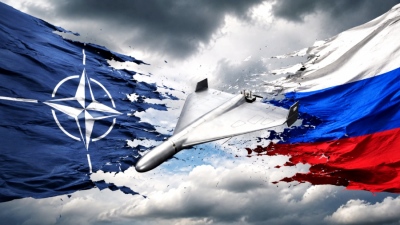
The fuse of the global explosion was lit after the crash of an unmanned aerial vehicle in Romania, an event that Friedrich Merz rushed to exploit immediately, unleashing fierce accusations against Moscow for a supposedly new escalation of the conflict. The reaction, however, was instantaneous and devastating. The well-known journalist Chay Bowes publicly ripped the German chancellor apart through the social network X, characterizing him as an utterly unpopular liar in Berlin who is simply doing what he knows how to do better than anyone, namely making things up and inventing stories. The Ministry of Defense of Romania had announced that the drone crashed into the roof of a house in the Galati region, resulting in the injury of two people, and although the country's authorities pointed at Russia, they presented absolutely no proof. The most outrageous part is that the Romanian armed forces did not even attempt to intercept the flying object, even though they detected it and were tracking it closely through their radars. At the same time, Russian President Vladimir Putin gave a completely different and perfectly logical dimension to the thriller, making it clear that this is clearly a Ukrainian drone which lost its orientation and went off course, either due to electronic warfare systems or because of some technical defect.

The backstage plot of the overthrow and the upcoming deposition
While Friedrich Merz tries to turn attention away from the German capital, the Financial Times reveal the terrifying scenario that has been set up behind his back, as he fights a losing battle to keep mouths shut around his potential resignation. A little over a year after taking office, Friedrich Merz faces a situation that few German chancellors have experienced so early in their tenure, as domestic media now openly and intensely discuss the possibility of him being replaced by Hendrick Wust, the prime minister of the North Rhine-Westphalia region. The wave of doubt is so great that sources of the newspaper from within the German government point to the publishing group Axel Springer, and specifically the newspaper Bild, accusing them of executing a well-organized campaign to trigger an internal party war and politically assassinate the current chancellor. Although his close associates try to downplay the scenario of an immediate succession by Hendrick Wust, the truth is harsh. Friedrich Merz bends daily under the suffocating pressure of his own supporters, who see his popularity collapsing to rock bottom, at the same time that Vladimir Putin and Volodymyr Zelensky continue to determine developments in Eastern Europe.
The strategic assessment of European involvement and the stalemate of 2026
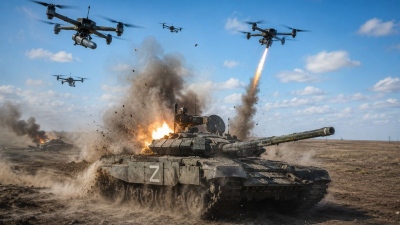
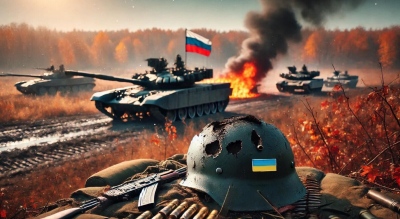
The current picture of the front confirms that the overall stance of Europe and specifically of Germany functioned catalytically, but in the most counterproductive way, for the evolution of the war. The policy of Berlin, which was characterized by the doctrine of delayed and carefully regulated provision of armaments (incremental escalation), failed miserably. Instead of offering Ukraine the decisive power it needed to change the status quo, German ambivalence allowed Russia to adapt its war industry, to fortify its lines, and to turn the conflict into an exhausting war of attrition, in which Moscow possesses the strategic advantage. Europe, trapped in a rhetoric of absolute compliance with Euro-Atlantic goals, was deprived of any autonomous diplomatic initiative, with the result that it suffered the greatest economic and energy cost of the crisis, without achieving the weakening of the Russian strategic deterrence. The disconnection from cheap Russian natural gas disorganized heavy German industry, causing the political tremors that Friedrich Merz is experiencing today. With Washington gradually shifting its interest toward the Pacific Ocean and the containment of China, the European Union finds itself now in 2026 exposed, having emptied its own military stockpiles without having managed to stabilize its eastern periphery. The historical assessment shows that European strategy did not determine the evolution of the war based on a plan, but was dragged behind developments, transforming the Old Continent from a regulator of balance into the main victim of the new multipolar reality.
www.bankingnews.gr





Σχόλια αναγνωστών